Baudhayana (Sanskrit: बौधायन, Romanised: Baudhāyana) was an ancient Indian mathematician and Vedic sage, believed to have lived around the 8th century BCE. He contributed to early Indian mathematics and geometry, primarily through his authorship of the Baudhayana Sutras. His birth anniversary is known as Baudhayana Jayanti or Bodhayan Jayanti or Bodhayan Janmotsav in the Mithila region.[1]
Birth
According to legend in the Mithila region, Baudhāyana is also called as Bhagwan Bodhayana. He was born on the Dwadashi (twelfth day) in Krishna Paksha of Pausha month in the Hindu calendar. He was born at the Bangaon village of the Bajpatti block in the Sitamarhi district of the Mithila region in the present state of Bihar in India. His childhood name was Upvarsha.[2][3] His father's name was Shankardutt and mother's name was Charumati. His father was a scholar of Pataliputra.[4]
Description
Baudhayana was a revered philosopher, skilled craftsman as well as a great Indian mathematician during 800 BC. He was the author of several ancient texts composed in the ancient Indian subcontinent. He composed more than two hundred texts. He gave many important theories of mathematics.[3]
In the text Ashtadhyayi, he is described as the guru of the famous Sanskrit grammarian Panini. He was a great scholar of philosophy, theology, mathematics and language. His important works were Vedvriti, Vedanta, Ratna Manjusha, Dharmasutra and Grihasutra.[3] Baudhayana Dharmasutra and Baudhayana Grihya Parishishta Sutra are the two major texts composed by him, which emphasize the ritualistic manner and philosophy of the Hindu tradition. His school of thought in Hindu tradition is known as Baudhayana Shakha or Baudhayana school. The Baudhayana Shakha consider the practices of image worship in Hinduism. It is affiliated to the Taittiriya recension of Krishna Yajurveda. In the Baudhayana school, Lord Vishnu is considered as the highest being and called as Mahapurusha. Apart from Lord Vishnu, it also considers all other deities in Hinduism as "Worthy of honor".[5]
Baudhayana is traditionally credited as the author of the Baudhāyana-Śrauta-sutra. It is the oral lectures delivered by him to his disciples and belongs to the Taittiriya recension of the Krishna Yajurveda.[6] The dates of these texts( Baudhāyana, Mānava and Apastambha) are given variously as between the 8th and 5th century BCE, with Baudhyana Sutras written around 800 BC.[7]. It contains a list of Pythagorean triples and a statement (without proof) of the Pythagorean theorem, both in the special case of the isosceles right triangle and in the general case.[8]
Mathematics
Baudhayana's primary historical legacy is his authorship of the Baudhayana Sulbasutra, which is recognized as one of the oldest Sulbasutras, though its exact dating is uncertain.[9][10] Because he was a Vedic priest and craftsman rather than a traditional mathematician in the modern sense, it is speculated that his work was motivated by religious necessities, such as the exact construction of ritual altars.[9]
Theorem of the Diagonal in the Sulbasutra of Baudhayana
In this text, the geometric principle equivalent to the Pythagorean theorem was expressed as bhujā-koṭi-karṇa-nyāya, which translates to "the principle of the base, the altitude and the diagonal." In this context, the term karṇa specifically denotes the hypotenuse.[11]
The Baudhayana Sulbasutra clearly outlines this rule in chapter 1, sutra 12 (BS 1.12):
"The areas (of the squares) produced separately by the length and the breadth of a rectangle together equal the area (of the square) produced by the diagonal."[11]
This rule is immediately followed by BS 1.13, by observations of this property in rectangles with specific integer side lengths (effectively describing Pythagorean triples). The pairs of the sides listed are: 3 and 4; 12 and 5; 15 and 8; 7 and 24; 12 and 35; and 15 and 36.
Prior to the general rule for the rectangles, BS 1.9 establishes the special case for the squares:
"The diagonal of a square produces double the area (of the square)."[11]
Approximation of root 2 and geometric solutions
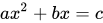
The Baudhayana Sulbasutra provides practical methods to solve basic linear equations using geometry. Additionally, quadratic equations of the forms and also appear within his construction rules. Chapter 1.61 of the text provides a remarkably accurate approximation for the square root of 2, calculating it correctly to five decimal places: which evaluates to approximately 1.4142156.[9][10][12]


Baudhayana Jayanti
Baudhayana Jayanti is majorly celebrated in the Mithila region. A grand ceremony of Baudhayana Jayanti is organised at the campus of the Swami Bodhayan Mandir in the Sitamarhi district of Bihar since 1957.[13][14] On the occasion of the celebration, Sadhu - Saints and sages are invited.[4] A 7-day long Shrimad Bhagwat Katha is organised in the campus of the temple. The preparation of the festive celebration starts a week before the Baudhayana Jayanti. It starts with celebration of a Kalash Sobha Yatra procession.[15] Every year a huge feast is organized here. A large number of devotees gather here on the Bodhayan Jayanti. They take sacred bath in the pond situated in the campus of the temple. They do parikrama and worship the statue of Bodhayan in the temple.[2]
The Bodhayan Janmotsav has been proposed as the status of state festival in Bihar by the state minister Jeevesh Mishra. In 2022, he assured the people of Mithila that the Bodhayan Jayanti would be given the status of a state festival through the Art and Culture department.[16]
References
- ↑ Divakaran, P.P (September 19, 2018). The Mathematics of India. Springer Nature Singapore. p. 46. ISBN 9789811317743.
- 1 2 "भगवान बोधायन की तपस्थली बोधायनसर को अब मिल सकेगी विश्वव्यापी ख्याति - Bodhanyansar, the ascetic place of Lord Bodhayan, will now be able to gain worldwide fame - Bihar Sitamarhi General News". Jagran (in Hindi). Retrieved 2025-07-13.
- 1 2 3 "गणितज्ञ बोधायन की जयंती आज, पर्यटन केंद्र के रूप में होगा विकसित -". Jagran (in Hindi). Retrieved 2025-07-12.
- 1 2 "तैयारियां पूरी, दार्शनिक गणितज्ञ भगवान बोधायन की जयंती आज". Dainik Bhaskar (in Hindi). 2019-01-02. Archived from the original on 2021-08-03. Retrieved 2025-07-12.
- ↑ Davis, Richard H. (2024-11-26). Religions of Early India: A Cultural History. Princeton University Press. ISBN 978-0-691-19926-9.
- ↑ "The Baudhayana Srauta-Sutra | IGNCA". Retrieved 2025-07-14.
- ↑ "Sulba Sutras (Indian Mathematics)" (PDF). Rutgers University. Retrieved 2026-06-07.
- ↑ Plofker, Kim (2009). Mathematics in India. Princeton University Press. pp. 17–18. ISBN 978-0-691-12067-6.
- 1 2 3 O'Connor, John J.; Robertson, Edmund F. "Baudhayana". MacTutor History of Mathematics Archive. University of St Andrews. Retrieved 9 June 2026.
- 1 2 Pearce, Ian G. "Mathematics in the service of religion: II. Sulba Sutras". MacTutor History of Mathematics Archive. University of St Andrews. Retrieved 9 June 2026.
- 1 2 3 Divakaran, P. P. (2018). The Mathematics of India: Concepts, Methods, Connections. Springer Nature Singapore. pp. 46–47. ISBN 978-9811317743.
- ↑ Gupta, R. C. (1972). "Baudhayana's value of √2". The Mathematics Education. 6: B77–B79.
- ↑ "बिहार के ऐसे गणितज्ञ...जिनकी थ्योरम प्रयोग कर आर्यभट्ठ ने की थी अंतरिक्ष की कई खोज, पाणिनि के थे गुरु". News18 हिंदी (in Hindi). 2024-12-20. Retrieved 2025-07-13.
- ↑ "भगवान बोधायन की जयंती आज" (in Hindi). 2024-12-27. Archived from the original on 2025-04-18. Retrieved 2025-07-13.
- ↑ "शोभायात्रा:बोधायन जयंती 20 को 14 को कलश शोभायात्रा". Dainik Bhaskar.
- ↑ "बोधायन गणितज्ञ ही नहीं बल्कि ज्योतिषाचार्य व वेदज्ञ थे: मंत्री". Hindustan.