
Artisanal, subsistence, or traditional fishing consists of various small-scale, low-technology, fishing practices undertaken by individual fishermen (as opposed to commercial fishing).[1] Many of these households are of coastal or island ethnic groups. These households make short (rarely overnight) fishing trips close to the shore. Their produce is usually not processed and is mainly for local consumption. Artisan fishing uses traditional fishing techniques such as rod and tackle, fishing arrows and harpoons, cast nets, and small (if any) traditional fishing boats. For that reason, socio-economic status of artisanal fishing community has become an interest of the authorities in recent years.

Artisan fishing may be undertaken for commercial, cultural and subsistence reasons. It contrasts with large-scale modern commercial fishing practices in that it is often less wasteful and less stressful on fish populations than modern industrial fishing. Target 14.b of Sustainable Development Goal 14 works to provide access rights to artisanal fishers on marine resources and markets.[2]
Importance
Hundreds of millions of people around the world rely on artisanal fisheries to live. Artisanal fishing is critically important for not only food, but for jobs, income, nutrition, food security, sustainable livelihoods, and poverty alleviation as well.[3][4] Artisanal fisheries are the predominant form of fisheries in "tropical developing countries" such as Nigeria.[5]
The importance of artisanal and small-scale fisheries have been recognized in the first internationally agreed instrument dedicated entirely to small-scale fisheries. This agreement, drafted by the Food and Agriculture Organization of the United Nations is titled the Voluntary Guidelines for Securing Sustainable Small-Scale Fisheries in the Context of Food Security and Poverty Eradication and was implemented in 2015.[6] In addition, there is increased global advocacy to provide access for small-scale artisanal fishers to marine resources and market, this is one of the major targets of the United Nations Sustainable Development Goal 14.[7]
Many subsistence and small-scale fishers, especially in tropical developing countries, depend on the fishing grounds that develop around mangrove forests. Mangroves provide breeding and nursery habitat for the fish, crustaceans and shellfish, which makes these areas a rich fishing resource.[8] More than four million people fish in mangroves worldwide, and these fisheries are an important source of food security and income for coastal communities.[9]
Artisan fishing boats and gears
Nigeria
A traditional dug out canoe between 3–18 meters long is used in Nigeria for artisanal fishing. Artisanal fishers in this area use gear that included, "cast nets, handlines, basket traps, longlines, set gillnets and beach and purse seines".[5]
Sudan
Fishing vessels used in Sudan include from the sharoaq, feluka and murkab al hadeed. Equipment varies by region and includes fixed nets, drift nets, seine nets, long line and cast nets.[10]
 Fishermen at work off the northern coast of Mozambique
 Fishing boats at Ko Kut, Thailand


Techniques
 Fish wheel used in Alaska
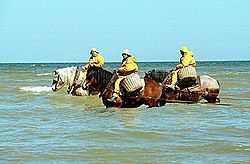 Shrimpers on horseback, Oostduinkerke, Belgium
 Fisherman landing his catch, Seychelles
 Fisherman and his catch, Seychelles. The fish, including small sharks, were hooked on hand lines many miles off shore.


 Fisherman with his net
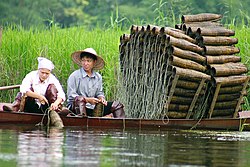 Traditional fish traps, Hà Tây, Vietnam
 Cormorants used for fishing in China


Indigenous people
Many indigenous people, particularly in coastal areas and near rivers, rely on fishing as their primary source of food.
See more

References
- ↑ Garcia, S.M. (2009). "Glossary". In Cochrane, K.; Garcia, S.M. (eds.). A fishery managers handbook. FAO and Wiley-Blackwell. pp. 473–505.
- ↑ "14.b.1 Access rights for small-scale fisheries | Sustainable Development Goals". Fao.org. Retrieved 29 January 2022.
- ↑ Whitty, T. "Artisanal Fisheries Impacts". Ocean Scientists for Informed Policy. Retrieved 31 March 2018.
- ↑ "Small-scale Fisheries". FI Institutional Websites. FAO Fisheries and Aquaculture Department. Retrieved 31 March 2018.
- 1 2 Inoni, O.E; Oyaide, W.J (2007). "Socio-Economic Analysis of Artisanal Fishing in the South Agro-Ecological Zone of Delta State, Nigeria". Agricultura Tropica et Subtropica. 40 (4).
- ↑ "Voluntary Guidelines for Securing Sustainable Small-Scale Fisheries in the Context of Food Security and Poverty Eradication" (PDF). Fao.org. Retrieved 29 January 2022.
- ↑ "Goal 14 targets". UNDP. Archived from the original on 2020-09-30. Retrieved 2020-09-24.
- ↑ Howai, Niko (2019). "Provisioning services of mangroves". Grantham Research Institute on Climate Change and the Environment. Retrieved 2026-06-17.
- ↑ zu Ermgassen, Philine S.E.; Mukherjee, Nibedita; Worthington, Thomas A.; Acosta, Alejandro; Rocha Araujo, Ana Rosa da; Beitl, Christine M.; Castellanos-Galindo, Gustavo A.; Cunha-Lignon, Marília; Dahdouh-Guebas, Farid; Diele, Karen; Parrett, Cara L.; Dwyer, Patrick G.; Gair, Jonathan R.; Johnson, Andrew Frederick; Kuguru, Baraka (6 December 2020). "Fishers who rely on mangroves: Modelling and mapping the global intensity of mangrove-associated fisheries". Estuarine, Coastal and Shelf Science. 247 106975. doi:10.1016/j.ecss.2020.106975.
- ↑ Anton, Paula; Curtis, Lori (2017). "Livelihoods of small-scale fishers along the Nile River in Sudan" (PDF). FAO. FAO. Retrieved 31 March 2018.
Sources
- FAO: Definition: Artisanal fisheries
- Béné, C; Macfadyen, G; Allison, E H (2007) Increasing the contribution of small-scale fisheries to poverty alleviation and food security FAO Fisheries Technical Paper T481. ISBN 978-92-5-105664-6
- Diegues, Antonio Carlos (2002) Sea Tenure, traditional knowledge and management among brazilian artisanal fishermen. NUPAUB, University of São Paulo. Retrieved 25 April 2008.
- Pauly, D (2006) Major trends in small-scale marine fisheries, with emphasis on developing countries, and some implications for the social sciences Maritime Studies (MAST) 4(2): 7–22.
- Tietze, U; Siar, S; Upare, Suchitra M and Upare, M A (2007) Livelihood and micro-enterprise development opportunities for women in coastal fishing communities in India FAO Fisheries Circulars C1021.
External links
- OAS: Report on fisheries including artisan fishing
- WorldFish Center: Small-Scale Fisheries
- CGIAR Research Program on Fish Agri-Food Systems: Small-Scale Fisheries


Fishing industry topics | |||||||||||||||
|---|---|---|---|---|---|---|---|---|---|---|---|---|---|---|---|
| |||||||||||||||
| |||||||||||||||

