Abrud (Latin: Abruttus;[3] Hungarian: Abrudbánya; German: Großschlatten) is a town in the north-western part of Alba County, Transylvania, Romania, located on the river Abrud. It administers three villages: Abrud-Sat (Abrudfalva), Gura Cornei (Szarvaspataktorka) and Soharu (Szuhár).
Population
| Year | Pop. | ±% |
|---|---|---|
| 1912 | 2,938 | — |
| 1930 | 2,468 | −16.0% |
| 1948 | 2,656 | +7.6% |
| 1956 | 4,411 | +66.1% |
| 1966 | 5,150 | +16.8% |
| 1977 | 5,315 | +3.2% |
| 1992 | 6,729 | +26.6% |
| 2002 | 6,803 | +1.1% |
| 2011 | 4,944 | −27.3% |
| 2021 | 4,360 | −11.8% |
| Source: INS, Census data | ||
At the 2021 census, Abrud had a population of 4,360. According to the census from 2011, the town had a total population of 4,944; of those, 96.66% were ethnic Romanians, 0.86% ethnic Hungarians, and 0.53% ethnic Romani.[4]
Name
The name likely came from the ancient name of the Abrud river. Although first recorded only in 1271 in the form terra Obruth, the name of the town might have derived from a hypothetical Dacian word for gold: "obrud".[5] The modern Hungarian name is Abrudbánya ("bánya" means mine in Hungarian). According to Hungarian linguists, the Romanian name Abrud was borrowed from the Hungarian form prior to a hypothetical 14th century vowel shift (from o to a), which has also been invoked to explain other borrowings of pre-conquest toponyms such as the Szamos and Maros rivers which also have disputed etymologies. Hungarian linguists claim that if the ancient form had survived directly into Romanian, then the extrapolation of linguistic patterns would favour the form Aurud.[6] In contrast, Romanian linguist Nicolae Drăganu claims that the Romanian form beginning with A was directly inherited from linguistic patterns in Romanized-Dacians (e.g. attested Dacian to Latin; Potaissa to Pataissa, Porolissum to Paralissum, etc.), while the Hungarian form beginning with O was borrowed from the Daco-Romans through Slavic mediation, where transformations from A to O are fairly common.[7]
History
Antiquity
The Romans erected a small fortification here in the 2nd century AD.[8] It was part of the defence system of the gold mines nearby, in "Alburnus Maior" (nowadays, Roșia Montană),[citation needed] but it was abandoned in the 3rd century.[8]
Middle Ages
Abrud was first recorded in 1271 in as terra Obruth.[5] It gained town status in 1427.
18th-century revolts
In 1727, the leaders of a revolt gained control of the town. Another serfs' revolt began in the area in 1784 with Horea, Cloșca and Crișan as leaders fighting the Austrian Imperial forces. Abrud was captured by the uprising's members on 6 November, before the revolt was crushed by the Austrian army.
1848 revolution
During the Hungarian Revolution of 1848, negotiations took place in Abrud between the leaders of the Romanian peasants, led by Avram Iancu and Ion Dragoș, the envoy of Lajos Kossuth, deputy of Bihar County in the Parliament of Budapest, regarding the conciliation of the Romanian and Hungarian revolutionary forces. On 6 May, in violation of the negotiated armistice, Major Imre Hatvani conducted a one-way action without any compliance by attacking and occupying Abrud which triggered the Abrud massacre. Hatvani embarked also on unnecessary killings, hanged Romanian lawyer Ioan Buteanu, while his drunken soldiers massacred prefect Petru Dobra. In the next two weeks 88 Romanians were killed in the central square, and around 2,500 Hungarians were killed in revenge by Iancu's army in Abrud and in Roșia Montană; Dragoș was also killed, being considered a traitor.[9] The escalated conflict could not be settled, Abrud was conquered and lost several times by the Hungarian troops, until 18 May when they retreated to Arad.[10]
Natives
Climate
Abrud has a humid continental climate (Cfb in the Köppen climate classification).
| Climate data for Abrud | |||||||||||||
|---|---|---|---|---|---|---|---|---|---|---|---|---|---|
| Month | Jan | Feb | Mar | Apr | May | Jun | Jul | Aug | Sep | Oct | Nov | Dec | Year |
| Mean daily maximum °C (°F) | 0.8 (33.4) |
2.8 (37.0) |
7.4 (45.3) |
13.7 (56.7) |
18 (64) |
21.2 (70.2) |
22.9 (73.2) |
23.3 (73.9) |
18.4 (65.1) |
13.2 (55.8) |
7.9 (46.2) |
2.2 (36.0) |
12.6 (54.7) |
| Daily mean °C (°F) | −2.7 (27.1) |
−1.1 (30.0) |
3.1 (37.6) |
9 (48) |
13.6 (56.5) |
17 (63) |
18.7 (65.7) |
19 (66) |
14.2 (57.6) |
9 (48) |
4.2 (39.6) |
−1 (30) |
8.6 (47.4) |
| Mean daily minimum °C (°F) | −5.9 (21.4) |
−4.7 (23.5) |
−1.2 (29.8) |
3.9 (39.0) |
8.5 (47.3) |
11.9 (53.4) |
13.8 (56.8) |
14.2 (57.6) |
10 (50) |
5.2 (41.4) |
1.2 (34.2) |
−3.8 (25.2) |
4.4 (40.0) |
| Average precipitation mm (inches) | 56 (2.2) |
53 (2.1) |
71 (2.8) |
97 (3.8) |
131 (5.2) |
149 (5.9) |
149 (5.9) |
108 (4.3) |
84 (3.3) |
62 (2.4) |
60 (2.4) |
66 (2.6) |
1,086 (42.9) |
| Source: https://en.climate-data.org/europe/romania/alba/abrud-44395/ | |||||||||||||
References
- ↑ "Results of the 2024 local elections". Central Electoral Bureau. Retrieved 17 December 2025.
- ↑ "2021 Romanian census". National Institute of Statistics. 1 December 2021.
- ↑ Ștefan Pascu: A History of Transylvania, Dorset Press, 1990, ISBN 978-0-88029-526-0, ISBN 0-88029-526-0
- ↑ "Structura Etno-demografică a României".
- 1 2 Makkai, László (2001). "Toponymy and Chronology". History of Transylvania Volume I. From the Beginnings to 1606 - III. Transylvania in the Medieval Hungarian Kingdom (896–1526) - 1. Transylvania'a Indigenous Population at the Time of the Hungarian Conquest. New York: Columbia University Press, (The Hungarian original by Institute of History Of The Hungarian Academy of Sciences). ISBN 0-88033-479-7.
- ↑ Makkai, László (2001). "Toponymy and Chronology". History of Transylvania Volume I. From the Beginnings to 1606 - III. Transylvania in the Medieval Hungarian Kingdom (896–1526) - 1. Transylvania'a Indigenous Population at the Time of the Hungarian Conquest. New York: Columbia University Press, (The Hungarian original by Institute of History Of The Hungarian Academy of Sciences). ISBN 0-88033-479-7.
- ↑ Drăganu, Nicolae (1920–1921). Din vechea noastră toponimie (in Romanian). pp. 129–135.
- 1 2 "1160.02". National Archaeological Record of Romania (RAN). ran.cimec.ro. 19 March 2009. Archived from the original on 19 February 2014. Retrieved 5 January 2013.
- ↑ "Az abrudbányai mészárlás". tortenelemportal.hu. Történelem portál. 10 May 2012.
- ↑ "Primăria Orașului Abrud – Istorie". primaria-abrud.ro (in Romanian). Retrieved 1 September 2020.
 Catholic church
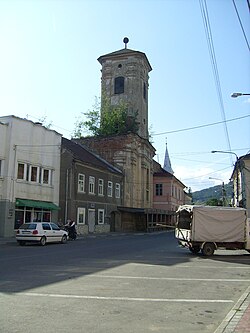 Unitarian and Calvinist churches
 Train station
 Panoramic view


| International | |
|---|---|
| National | |
