
News, announcements, release info, and calendar updates
from the Unicode Consortium
Wednesday, November 15, 2023
Looking to give back differently for this #GivingTuesday?
![[image of 3 badges]](https://www.unicode.org/announcements/gold-silver-bronze-horiz.png)
Now you can adopt a character and show off your hobby or business, favorite sport, or love. For that special someone who seems to have everything, you can also give a unique gift.
Allergies? 🤧 Traveling? ✈️ No worries, the cat emoji 😺 has no fur and requires no feeding! The dog emoji 🐶? No need to go out for a 3 am walk! Looking to be a Scrabble champ? The strong and fast letter Z is right for you!
Your good friend is studying to be a doctor. How about the stethoscope emoji as a gift? 🩺Or even an emoji to support your favorite college football team this season! 🏈
With nearly 150,000 characters there's something for everyone! The possibilities are endless! It's also a tax-deductible donation in the United States, to the extent allowed by law. Your company may also provide matching funds.
☯🏏 🏈 ⚽ 🔥🎁💍爱戀🥳 🙌 🎂💗💟₨ ₪ € ₭ ₱🥰 😍♕Ωπ
About Adopt-a-Character
The Adopt-a-Character program was launched in 2015 to support Unicode's mission to ensure everyone can communicate in their own languages. Adopt-a-Character funds have supported work on historic scripts, including Old Uyghur, Old Sogdian, Sogdian, Seal Script (China), and Mayan Hieroglyphs, and Egyptian Hieroglyphs. Additional support has been provided to encode the modern scripts Hanifi Rohingya, Tolong Siki, and Sunuwar, among others.
Characters can be adopted at three levels:
Gold - $5,000
For any particular character there can only be one Gold adoption!
Be the only!
Silver - $1,000
For any particular character there can only be five Silver adoptions! Be one of the five to adopt your favorite characters as a Silver adopter!
Bronze - $100
For any character, there are an unlimited number of Bronze-level adoptions! Also a wonderful option!
Each adoption is recognized with a digital badge that you (or your recipient!) can proudly share via your social channels and via websites. Adoptions also come with a digital certificate that you can print to display or email to your giftee!
About the Unicode Consortium
The Unicode Consortium is the premier 501(c)3 non-profit, open source, open standards body for the Internationalization of software and services. It is arguably the most widely deployed software in the world available across 20 billion devices and counting! At its core, Unicode enables people around the world to communicate in any language.
And - if you want to simply make a donation to support Unicode’s work, you can do that, too!
This Giving Tuesday, let's come together to continue to celebrate and preserve linguistic diversity. Adopt a character and make a difference!
Support Unicode
To support Unicode’s mission to ensure everyone can communicate in their languages across all devices, please consider adopting a character, making a gift of stock, or making a donation. As Unicode, Inc. is a US-based open source, open standards, non-profit, 501(c)3 organization, your contribution may be eligible for a tax deduction. Please consult with a tax advisor for details.
![[badge]](https://www.unicode.org/announcements/ynh-pink-heart.png)
Silver - $1,000
For any particular character there can only be five Silver adoptions! Be one of the five to adopt your favorite characters as a Silver adopter!
Bronze - $100
For any character, there are an unlimited number of Bronze-level adoptions! Also a wonderful option!
Each adoption is recognized with a digital badge that you (or your recipient!) can proudly share via your social channels and via websites. Adoptions also come with a digital certificate that you can print to display or email to your giftee!
About the Unicode Consortium
The Unicode Consortium is the premier 501(c)3 non-profit, open source, open standards body for the Internationalization of software and services. It is arguably the most widely deployed software in the world available across 20 billion devices and counting! At its core, Unicode enables people around the world to communicate in any language.
And - if you want to simply make a donation to support Unicode’s work, you can do that, too!
This Giving Tuesday, let's come together to continue to celebrate and preserve linguistic diversity. Adopt a character and make a difference!
Support Unicode
To support Unicode’s mission to ensure everyone can communicate in their languages across all devices, please consider adopting a character, making a gift of stock, or making a donation. As Unicode, Inc. is a US-based open source, open standards, non-profit, 501(c)3 organization, your contribution may be eligible for a tax deduction. Please consult with a tax advisor for details.


Monday, November 13, 2023
UTC #177 Highlights
by Peter Constable, UTC Chair
Unicode Technical Committee (UTC) meeting #177 was held November 1 to 3 in Cupertino, California, hosted by Apple. Here are some highlights from the meeting.
Starting the Unicode 16.0 cycle
UTC approved a plan and timeline for the Unicode 16.0 release. Here’s a summary of the timeline:
Unicode 16.0 character and emoji repertoire
UTC had previously approved 1,179 characters for encoding in Unicode 16.0. At this UTC meeting, 15 additional characters were approved for version 16.0, including seven emoji characters. UTC has been planning to include nearly 4,000 additional Egyptian Hieroglyphs in Unicode 16.0. The proposal was discussed, and a small revision was requested. It’s expected these will be approved for Unicode 16.0 at the next UTC meeting. Apart from the additional hieroglyphs, we expect no further characters will be added to the Unicode 16.0 repertoire.
Beside characters approved for Unicode 16.0, code points were provisionally assigned for 184 new characters that are candidates for encoding in a future Unicode version.
See the Pipeline page for all characters currently approved for Unicode 16.0, along with code points provisionally assigned for future encoding.
Future of UAX #42, UCD in XML
UAX #42, Unicode Character Database in XML (UCDXML), was originally developed by Eric Muller. He and Laurentiu Iancu maintained UCDXML through many versions, and we’re very grateful for this contribution. Eric and Laurentiu are no longer available to maintain this, however, and no others have volunteered to take over maintenance. After discussion over several months in UTC and in the Properties and Algorithms working group, UTC has concluded the best option for the future of UAX #42 is to stabilize it, with data frozen at Unicode 15.1. A Public Review Issue will be posted to get feedback on this plan.
Future maintenance of UCS repertoire
UTC discussed a proposal for ISO/IEC JTC 1/SC 2 to adopt different process for future maintenance of the repertoire of ISO/IEC 10646 using a maintenance agency rather than the process that is used for developing entirely new standards, as done in the past. It was felt that this would be more agile and would align better to how expert input has guided actual encoding decisions for several years now. This proposal will be formally submitted to JTC 1/SC 2 as a proposal from the US national standards body.
Full details on these and other outcomes are provided in the minutes—see L2/23-231.
Support Unicode
To support Unicode’s mission to ensure everyone can communicate in their languages across all devices, please consider adopting a character, making a gift of stock, or making a donation. As Unicode, Inc. is a US-based open source, open standards, non-profit, 501(c)3 organization, your contribution may be eligible for a tax deduction. Please consult with a tax advisor for details.
Unicode Technical Committee (UTC) meeting #177 was held November 1 to 3 in Cupertino, California, hosted by Apple. Here are some highlights from the meeting.
Starting the Unicode 16.0 cycle
UTC approved a plan and timeline for the Unicode 16.0 release. Here’s a summary of the timeline:
- January 2024: UTC #178 will finalize content for the alpha release
- February – March: alpha release for public review
- April: UTC #179 will finalize content for the beta release
- May – June: beta release for public review
- July: UTC #180 will finalize 16.0 content
- September: Unicode 16.0 release
Unicode 16.0 character and emoji repertoire
UTC had previously approved 1,179 characters for encoding in Unicode 16.0. At this UTC meeting, 15 additional characters were approved for version 16.0, including seven emoji characters. UTC has been planning to include nearly 4,000 additional Egyptian Hieroglyphs in Unicode 16.0. The proposal was discussed, and a small revision was requested. It’s expected these will be approved for Unicode 16.0 at the next UTC meeting. Apart from the additional hieroglyphs, we expect no further characters will be added to the Unicode 16.0 repertoire.
Beside characters approved for Unicode 16.0, code points were provisionally assigned for 184 new characters that are candidates for encoding in a future Unicode version.
See the Pipeline page for all characters currently approved for Unicode 16.0, along with code points provisionally assigned for future encoding.
Future of UAX #42, UCD in XML
UAX #42, Unicode Character Database in XML (UCDXML), was originally developed by Eric Muller. He and Laurentiu Iancu maintained UCDXML through many versions, and we’re very grateful for this contribution. Eric and Laurentiu are no longer available to maintain this, however, and no others have volunteered to take over maintenance. After discussion over several months in UTC and in the Properties and Algorithms working group, UTC has concluded the best option for the future of UAX #42 is to stabilize it, with data frozen at Unicode 15.1. A Public Review Issue will be posted to get feedback on this plan.
Future maintenance of UCS repertoire
UTC discussed a proposal for ISO/IEC JTC 1/SC 2 to adopt different process for future maintenance of the repertoire of ISO/IEC 10646 using a maintenance agency rather than the process that is used for developing entirely new standards, as done in the past. It was felt that this would be more agile and would align better to how expert input has guided actual encoding decisions for several years now. This proposal will be formally submitted to JTC 1/SC 2 as a proposal from the US national standards body.
Full details on these and other outcomes are provided in the minutes—see L2/23-231.
Support Unicode
To support Unicode’s mission to ensure everyone can communicate in their languages across all devices, please consider adopting a character, making a gift of stock, or making a donation. As Unicode, Inc. is a US-based open source, open standards, non-profit, 501(c)3 organization, your contribution may be eligible for a tax deduction. Please consult with a tax advisor for details.
Wednesday, November 1, 2023
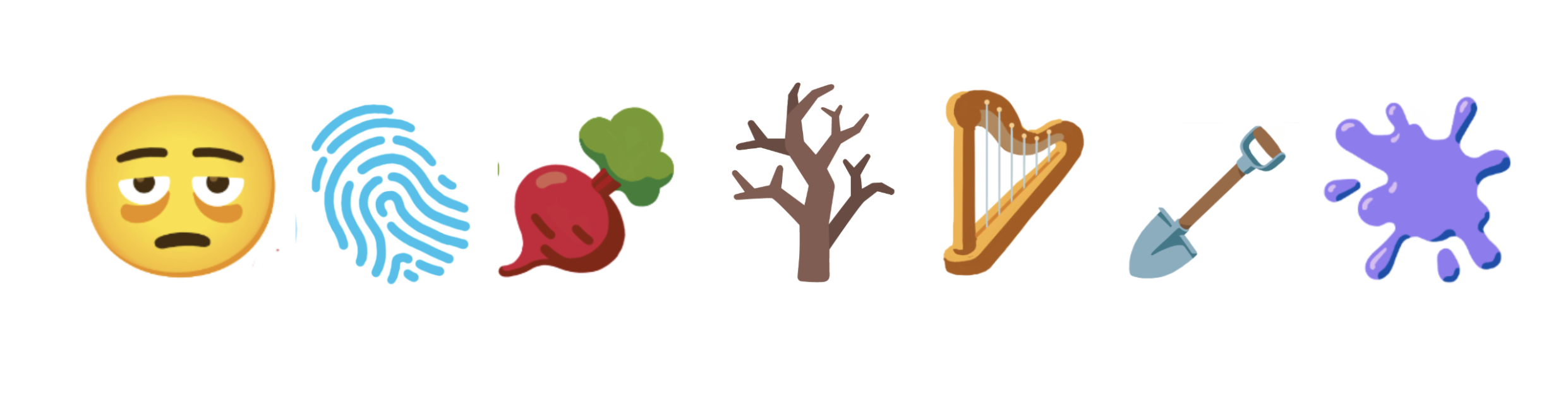
What do a leafless tree, a fingerprint, and a harp have in common?
This is not a set up to a riddle. This is Emoji 16.0.
By Jennifer Daniel, Chair of the ESC
This week, the Unicode Technical Committee gathered for our last meeting of 2023
to discuss the encoding, data files, and list of characters related to
digitizing the world’s languages. Amongst the topics discussed were emoji and as
a result seven new characters are on their way for inclusion into the Unicode
Standard, into your keyboards, and into your hearts ;-)
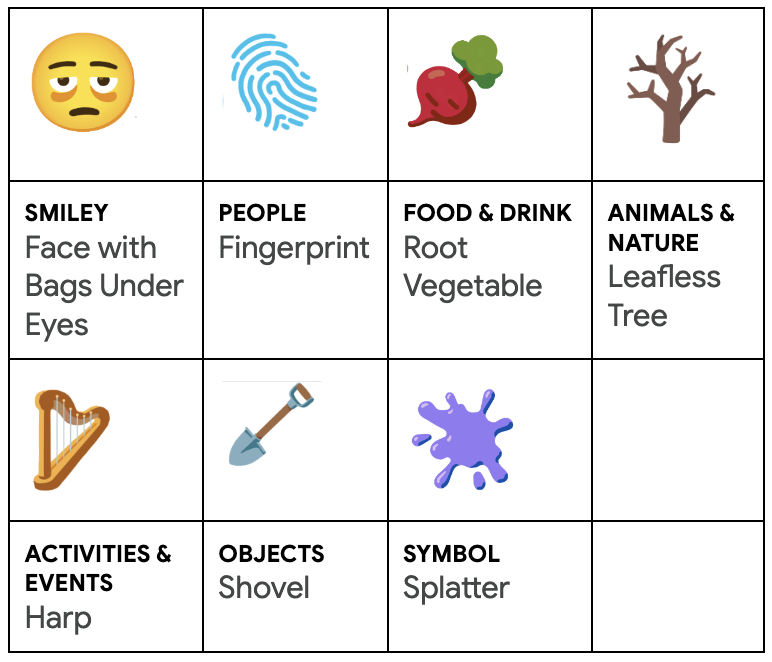
The final recommendations culminated in seven emoji: one emoji per major category.
An incredibly powerful aspect of written language is that it consists of a finite number of characters that can “do it all”. And yet, as the emoji ecosystem has matured over time our keyboards have ballooned and emoji categories are about to hit — or have hit — a level of saturation. Upon reflecting on how emoji are used, the Unicode Emoji Subcommittee (ESC) has entered a new era where the primary way for emoji to move forward is not merely to add more of them to the Unicode Standard, but to consider how the ones added provide the most linguistic flexibility. As a result, the ESC approves fewer and fewer emoji proposals every year.
The few that are added this year have demonstrated their adaptability in different contexts — take for example, fingerprint. It is commonly used to represent multiple concepts. Fingerprints are a symbol of identity (unique as you), security (as a passkey), and forensics (what crime show logo is complete without a fingerprint?). While we think of fingerprints as a relatively modern phenomenon according to Forensics Digest, the earliest use of fingerprints dates back to 1000 B.C.
In fact all of this year’s emoji candidates have deep roots in history. Harps have been known since antiquity in Asia, Africa, and Europe, dating back at least as early as 3000 BCE. Today it has political, sporting, corporate, and religious symbolism 👼 Leafless trees have been around as long as ... well, trees (and poetry!) I suppose. Leafless trees literally represent droughts or winter and metaphorically indicate a state of barrenness and death.
Shovel isn’t just another noun — sure, yes, it’s a tool commonly found in your shed — in our keyboards, however, it’s also a verb. Digging yourself out of a hole, digging yourself into a hole, shoveling 💩, it does it all. But wait, there’s more. Splatter is one of those stealth emoji that when you look at you might be thinking, “really, another sex emoji?” (To be honest, show me someone who doesn’t think an emoji is a sex emoji and I’ll show you someone who lacks imagination). Splatter is a spill. Splatter is expressive. Splatter is soft — a perfect counterpoint to collision 💥 — the bouba to 💥’s kiki.
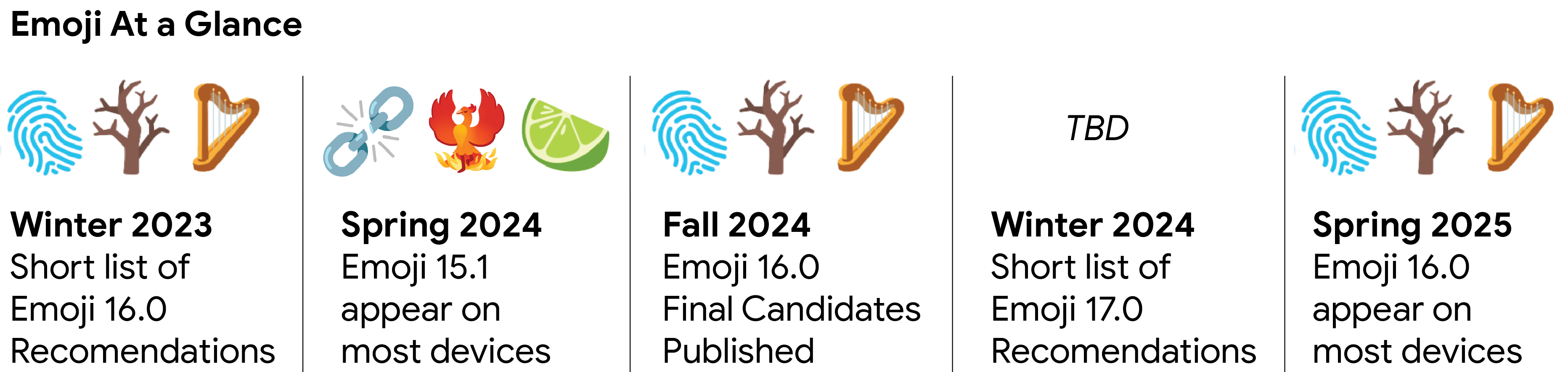
Emoji 16.0 has a long road ahead and will appear on most devices in May-June 2025.
Support Unicode
To support Unicode’s mission to ensure everyone can communicate in their languages across all devices, please consider adopting a character, making a gift of stock, or making a donation. As Unicode, Inc. is a US-based open source, open standards, non-profit, 501(c)3 organization, your contribution may be eligible for a tax deduction. Please consult with a tax advisor for details.
By Jennifer Daniel, Chair of the ESC
The final recommendations culminated in seven emoji: one emoji per major category.
An incredibly powerful aspect of written language is that it consists of a finite number of characters that can “do it all”. And yet, as the emoji ecosystem has matured over time our keyboards have ballooned and emoji categories are about to hit — or have hit — a level of saturation. Upon reflecting on how emoji are used, the Unicode Emoji Subcommittee (ESC) has entered a new era where the primary way for emoji to move forward is not merely to add more of them to the Unicode Standard, but to consider how the ones added provide the most linguistic flexibility. As a result, the ESC approves fewer and fewer emoji proposals every year.
The few that are added this year have demonstrated their adaptability in different contexts — take for example, fingerprint. It is commonly used to represent multiple concepts. Fingerprints are a symbol of identity (unique as you), security (as a passkey), and forensics (what crime show logo is complete without a fingerprint?). While we think of fingerprints as a relatively modern phenomenon according to Forensics Digest, the earliest use of fingerprints dates back to 1000 B.C.
In fact all of this year’s emoji candidates have deep roots in history. Harps have been known since antiquity in Asia, Africa, and Europe, dating back at least as early as 3000 BCE. Today it has political, sporting, corporate, and religious symbolism 👼 Leafless trees have been around as long as ... well, trees (and poetry!) I suppose. Leafless trees literally represent droughts or winter and metaphorically indicate a state of barrenness and death.
Shovel isn’t just another noun — sure, yes, it’s a tool commonly found in your shed — in our keyboards, however, it’s also a verb. Digging yourself out of a hole, digging yourself into a hole, shoveling 💩, it does it all. But wait, there’s more. Splatter is one of those stealth emoji that when you look at you might be thinking, “really, another sex emoji?” (To be honest, show me someone who doesn’t think an emoji is a sex emoji and I’ll show you someone who lacks imagination). Splatter is a spill. Splatter is expressive. Splatter is soft — a perfect counterpoint to collision 💥 — the bouba to 💥’s kiki.
When can you get these new emoji?
A simple question that deserves a simple answer. Alas, you’re dealing with Unicode so the answer is complex. Did you know it can take up to two years to encode an emoji? It’s true. If we want the symbols we digitize to truly “just work” across the entirety of not just the Internet but all digital surfaces … it takes time. So, don’t expect to see these characters anytime soon. In fact, despite the previous batch of emoji (phoenix, lime, broken chain, etc.) getting approved last year they still haven’t landed on your device of choice yet but are well on their way to pop up in the first half of 2024.
Emoji 16.0 has a long road ahead and will appear on most devices in May-June 2025.
Support Unicode
To support Unicode’s mission to ensure everyone can communicate in their languages across all devices, please consider adopting a character, making a gift of stock, or making a donation. As Unicode, Inc. is a US-based open source, open standards, non-profit, 501(c)3 organization, your contribution may be eligible for a tax deduction. Please consult with a tax advisor for details.
Subscribe to:
Comments (Atom)
Subscribe to this blog


 Posts
Posts